
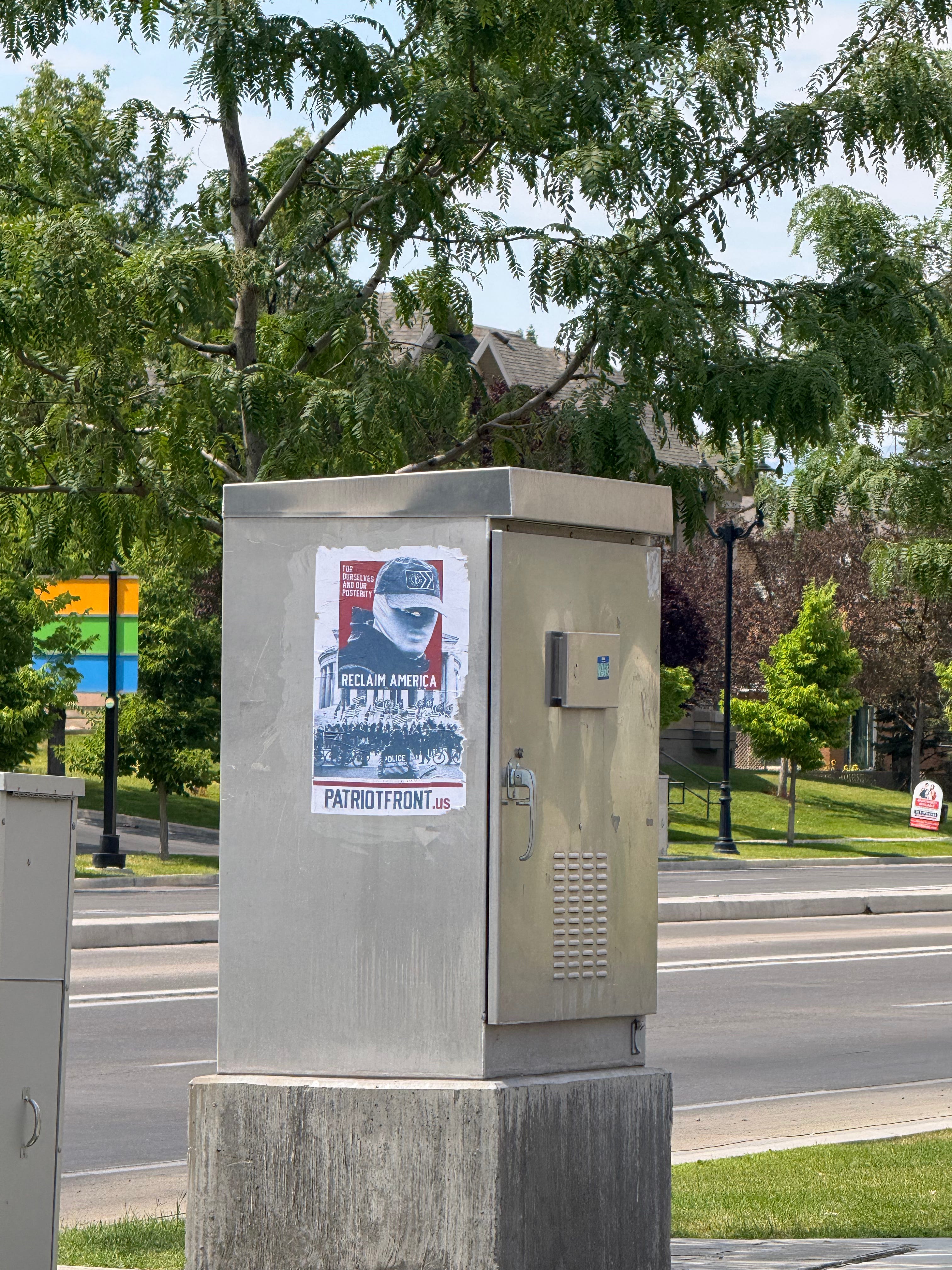
I saw it while driving to a family function, squinted my eyes, wasn’t quite sure I was seeing what I was seeing. When I drove back home, late that night, I parked in the Provo Library lot just to double check. My eyes hadn’t deceived me the first time. Someone had plastered a white supremacist ad onto the utilities box right by the library, by one of Provo’s busiest intersections. I took a picture, climbed back into my car, sat there, and wondered: How will the Latter-day Saints react?
That’s the chief question. Seeing such a sign in Provo, Utah is an indication that soul-changing questions, the kind that confronted Christ and His apostles back in the day and throughout time, have crawled up to our very doors. The sign was torn at the edges and slightly graffited with people’s recriminations against it; nevertheless, whoever had posted it had used something very sticky. I touched it myself just to test. It wasn’t coming off easily.
I want to quickly elaborate on how I know the sign was a white supremacist advert and who the white supremacists are, just to assure you that I’m not blowing hot air. It was a sign by the Patriot Front, whose website reads: “Americans will fully recognize themselves as a people… bearing a unique national interest rooted in our heritage on this continent. Our people, born to this nation of our European race, must reforge themselves as the new collective capable of asserting our right to cultural independence.” One of the smaller white supremacist groups out there, they hope that America will become a white ethnostate. Their end-goal is to eventually end democracy, believing it has failed America by allowing too many voices to determine the direction of the nation. They recently captured national headlines when they marched through Washington, D.C. on July 4 for the country’s 250th birthday celebration, waving Confederate flags as they went, describing immigrants as invaders and America as the rightful belonging of white men. Finally, it is worth noting that the sign was posted during the week that Tyler Robinson, who is on trial for the assassination of Charlie Kirk, whom some white supremacists praised, was given a preliminary hearing in Provo, just a few blocks away from the poster. Charlie Kirk’s widow Erika Kirk was in town for the hearing, as well as Donald Trump, Jr.
I am involved in a number of political peacemaking efforts with BYU. I’m a researcher in an AI lab where we’re trying to craft LLMs able to help individuals practice communicating with someone who is difficult or outright hostile. I’m an officer of the student-led Peacemaker Project, where I produce a podcast that has brought together partisans from across campus and the aisle. I recently traveled to Philadelphia for a conference with Braver Angels, an organization specifically dedicated to bringing together partisans. I TAed for a politics- and religion-related peacemaking class last semester where we practiced communicating about hard subjects.
These are all great things. They are. BYU and Latter-day Saints in general are so, so good at seeking peace and finding practical ways to establish it. But sometimes—and increasingly more often—I walk away from each activity with ashes in my mouth. We keep practicing how to talk about an issue. Where guns should be allowed. How much should the rich pay in taxes. Is climate change a worthy government objective. We even sometimes touch on harder subjects, like is abortion ever okay.
But we handle such topics with kid gloves, and we never dare to go past them, to practice talking about the real issues that might make someone cry, or scream, or swear, or start a revolution—like, are all races really equal. Should a woman’s opinion be weighted the same as a man. Should the things God has given me be extended to others. Or the hardest question of all: when I look you in the eyes, should I view you as a child of God, should I see you as someone just as beloved, just as precious, just as real and noble and deserving by birthright as I am.
Or shouldn’t I.
I don’t know if a Latter-day Saint hung up the sign. I don’t know if Latter-day Saints tried to rip the sign off. But while I drove the miles home the question stared me in the face. How do I react as a Latter-day Saint? When an exclusionary doctrine comes knocking at my door, what do I do? How will my fellow believers react—what will they say?
This question is not a question of politics. It is a question that goes back to ancient times, back when Jesus radically defied custom and expectations in a region strictly segregated by class and gender and race and country. It goes back even further, to when the Lamanites and Nephites brawled for land in unrighteous wars. It goes back to Cain, who looked at Abel and thought my happiness is worth more than you. In other words, the question facing the Latter-day Saints is—does God love all His children equally, or not?
“He inviteth them all to come unto him and partake of his goodness; and he denieth none that come unto him, black and white, bond and free, male and female... all are alike unto God,” writes the prophet Nephi (2 Nephi 26:33).
“They are like unto you,” the prophet Jacob tells the Nephites while he recriminates them for “reviling” the Lamanites over their skin color (Jacob 3:9).
“There were no robbers, nor murderers, neither were there Lamanites, nor any manner of -ites,” records Mormon in 4 Nephi 1:17, describing the idyllic period of time born of the teachings imparted by Christ after His visit to the Americas.
If we believe these scriptures, then the natural action for people who have learned, from holy writ (3 Nephi 27:27) and the words of ancient (Moroni 7:48) and modern prophets (Dallin H. Oaks, “The Challenge to Become”) that becoming like God is our chief imperative in life, then we must love God’s children equally, too.
And now I know there are plenty of ways to interpret such words—to use them to justify hurting someone because “it’ll help them” or because loving them might not serve somebody else’s interests. Those consequences are for God to consider: the actions we take are not—those have been circumscribed by the Lord. The point is: God has commanded us to love His children equally. Now: do you actually love the person for whom you are deciding law and policy? I’m a woman. When a man tries to tell me how a woman should think and act, if she should stay in the home or go out and work, what her place is, is he saying it because he just thinks so, or because he loves me? Only the second motive can imbue his advice with the Spirit. And it is not possible for anyone to love someone whom they have not approached with curiosity, questions, and a willingness to understand.
In Moroni 7:45, the aged, hidden, hunted prophet Moroni records: “Charity suffereth long, and is kind, and envieth not… seeketh not her own… endureth all things.
“Charity is the pure love of Christ, and it endureth forever; and whoso is found possessed of it at the last day, it shall be well with him.”
It is my hope that all believers will be possessed of charity at the last day. It is my hope that we will be possessed of it now, too. As white supremacism and other forms of exclusionary extremism show their faces more proudly, more unflinchingly in the daylight, it is up to us to decide as a community if we will leave such signs up—or take them down. As individuals: if we will permit the spread of such actions and rhetoric with inaction and acceptance—or not. The poster of the sign left it in hopes that we are a people that leave such things up. Are we?