
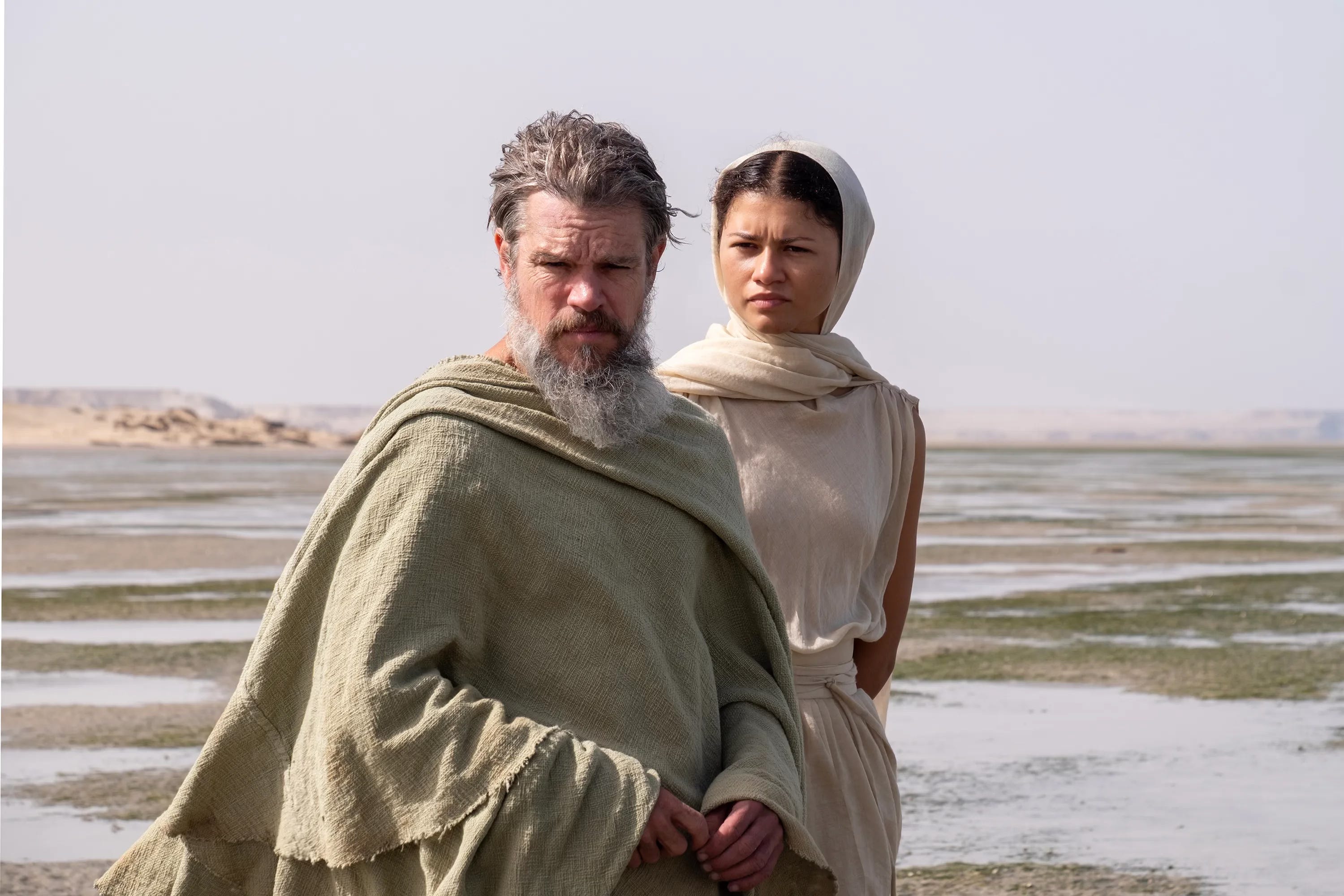
Christopher Nolan’s Odyssey attracted almost as much criticism before its arrival than after: Internet warriors complained about the American accents, decried the casting of transgender and Black actors in relatively prominent roles, and, of course, asserted the futility of trying to compress twenty-four books of ancient epic into a something that a modern audience can sit through. That last point holds the most weight—it is arguably impossible to try to cram all of Homer’s original yarn into a compelling film, what with the original Odyssey’s complexities, vagarities, and ancient Greekisms. The point is—the original Odyssey, as told by Homer, likely would have made a boring film for modern audiences with poor understandings of ancient Greek culture. To Nolan’s everlasting credit, he didn’t even try. Instead, he wrote a film specifically for the modern viewer—and, apparently, for the modern American.
Nolan’s Odyssey hinges on a narrative thread mentioned relatively infrequently in the original epic. Telemachus supplies the thread early in the film, watching his mother’s suitors eat through yet another year of the palace stores: these suitors are violating xenia, the law of Zeus. In Homer’s world, xenia is the sacred obligation between host and guest; a traveler could expect food and shelter from strangers, though they owed respect in return. The law of Zeus functioned as an omnipresent safety net in a lethal ancient world where traveling necessarily meant placing yourself at the mercy of strangers. The rule was enforced by the Greek gods themselves, on the theory that you never know when the stranger at your door might actually be a deity in disguise.
“It’s supposed to keep people on the straight and narrow,” Nolan told Variety in a recent interview, comparing the law of Zeus to the Golden Rule. “I was interested in the idea that the interdependence of people is the foundation and possibly the definition of civilization.”
The Golden Rule—the straight and narrow—people need each other, and that social contract, composed of kindness and mercy, underscores the entire film. However, as is typical of Nolan, he doesn’t make this quite plain until the very end of the film. There, he frames the Trojan Horse—Odysseus’s masterpiece, the trick that won the war on Troy—as the act that shattered xenia’s sanctity: a gift that wasn’t a gift, the weaponization of hospitality, a meaningless betrayal. This is important—Odysseus used the expectations of xenia to win the war; he benefitted from the law while making sure to break it with self-serving betrayal. His violation of xenia then places him and his men outside of the gods’ favor. From that moment on, Odysseus crosses into a world that forces him to understand what it is like to live outside the social contract: in this world, hosts bewitch guests, guests plunder and hurt hosts, and the ocean becomes stormy and jagged with broken guarantees.
Nolan’s film is a powerful note of conscience for an America currently bitterly divided over birthright citizenship. Immigration is, and has always been, our xenia: we are a country of immigrants; even the most foundational members of the dominant white subculture trace their American lineage back to immigrants. Birthright is how all white Americans came to be. The Fourteenth Amendment is the promise that a child born here belongs here, regardless of who her parents are or how they arrived—whether that be by slaughtering Native Americans and plundering their crops or by overstaying a work visa. It is, in short, the mechanism by which every proud American reading this became American. It is not a privilege that was earned, but a gift freely given.
Some Americans, led by U.S. President Donald Trump, are marshalling sociocultural, political, and legal pressures to end it.
Now, there are many issues with birthright citizenship and broader policies attached to unchecked immigration. I don’t have time or space to delve into the constraints and limitations imposed by the practicalities of granting citizenship to massive numbers of people whose intentions may not always be positive. But the basic morality of the principle—allowing hospitality to others the same way you have been granted hospitality—has implications for Americans generally, as well as Christians in particular.
I was interested in the idea that the interdependence of people is the foundation and possibly the definition of civilization. — Christopher Nolan
Regarding Americans generally: the public, to its credit, is not enthusiastic about reversing birthright citizenship. Roughly two-thirds of Americans support keeping the guarantee made by the Fourteenth Amendment, with majorities among independents and a substantial share of Republicans. Support holds across region, race, and party—unusual for a country that seems unusually divided at present. As the head of the PRRI put it after their December survey: ending birthright citizenship is simply not something that the American public wants.
But majority opposition isn’t the only thing that can kill a constitutional guarantee. It only takes some people and a couple of authorities who are willing to treat the Fourteenth Amendment as optional. The suitors in Ithaca were not a majority of Greeks; they were a few dozen men who decided the rule didn’t apply to them, in a house whose owner was presumed too far away to object. If partisans wish to end birthright citizenship, they can start to harass immigrants right now—and in many ways, including through strict detention policies and unnerving ICE work, including actions that have resulted in the deaths of several American citizens, they have already begun.
Nolan’s $250 million, wildly popular movie warns of the consequences of such a course of action. Hospitality is not charity, it is infrastructure; xenia protected the traveler because everyone, eventually, travels, and in ancient society, you would die if the stranger at the end of the road didn’t take you in. Xenia was crafted by people who knew they would someday need it. Likewise, birthright citizenship protects all groups of people. Right now, white Americans are the dominant culture; in a hundred years’ time, two hundred years’ time, that may not be the case, no matter how hard some partisans try. What will happen then if America is a country built around race and not around creedal mercy and hospitality? If the latter identity is smashed up, the descendants of the Americans who benefit in the short term will, at some point in either the near or far future, suffer. We know this: we see this when the presidency turns over and Trump starts to investigate his opponents, when a political party like the Democrats returns to power and begin to reverse Republican policies, when disasters or wars strike and it turns out we need our fellow countrymen, as when Black soldiers who had long suffered under Jim Crow laws fought for the country alongside white soldiers in World War II, and when international politics go sour and we need our allies, as when Iran tightened its grip on the Strait of Hormuz and America called on European nations for help.
Nolan’s film ends with Odysseus home, having killed the men who ate his house, standing in a kingdom he no longer entirely recognizes. He sends himself to exile because he recognizes that Ithaca is no longer a safe place for him; his own actions have led to his ruin. In Nolan’s Odyssey, the end is not a triumph; it is a man discovering what it costs to live in a world where the old guarantee no longer holds. As it turns out: it is a highly unpleasant world where everyone treats him according to the same standard which he treated them.
Regarding Christians: In the film, Nolan couches his message of hospitality in religious framing. Odysseus’s smashing of the hospitality by which he had benefitted leads to a withdrawal of favor from the gods.
Among those who have benefitted the most from birthright citizenship are many white American Christians, some whom descend from Europeans who were persecuted for their beliefs and fled to the New World for refuge. It is this demographic—white Christians, the most reliably churchgoing constituency in the country and the most reliably right-wing constituency in the country—that, among the religious, are the least likely to support birthright citizenship. This group—and I count myself among them!—has benefitted so much from being allowed to stay in a country to which our ancestors did not belong; if we do not extend this same privilege to others, then we risk the withdrawal of favor from our God, who asked us to extend the same mercy we are shown to others.
Christians’ sacred text is unusually direct concerning the Golden Rule. It is a message repeated time and again in scripture. I was a stranger, and ye took me in (Matthew 25:35). The Samaritan who stops on the road is the hero of the parable precisely because he owes the wounded man nothing (Luke 10:25–37). Do unto others as you would have them do unto you (Matthew 7:12)—which, for a descendant of immigrants weighing whether to close the door behind him or her, is not an abstraction, but an audit.
Christian institutions know this. The Evangelical Immigration Table has spent years reducing the biblical position to three words: welcome the stranger. Fuller Theological Seminary has said the same. The Catholic bishops, in a rare joint pastoral message, condemned indiscriminate mass deportation by a vote of 216 to five. A hundred fifty-four Episcopal bishops asked: whose dignity matters? The pulpits are largely holding, but the pews have ideologically drifted.
Homer’s gods punished the violation of hospitality because they understood it as the load-bearing wall of civilization: remove it, and the house will come down on everyone inside. The Christian formulation is just as direct. Whatever you did not do for the least of these, you did not do for me.
Birthright citizenship is a privilege; being an American is a privilege; any of the blessings of God are privileges, and ones we should not be quick to withhold from others. This was the message I heard when the Trojan Horse opened up and Odysseus’s boots hit the cobblestone beneath.